waizui
Let’s build a GPT-1 (II)
In part I, I explained how embedding works. In this part, let’s delve into how the attention mechanism works.
Attention Is All You Need
The foundation that powers transformers is Scaled Dot-Product Attention, which is:
\[\text{Attention}(Q,K,V) = \text{softmax} \left( \frac{QK^T}{\sqrt{d_k}} \right) V\]where $Q, K, V$ are Query, Key, and Value respectively. $d_k$ is the dimension of $Q$ and $K$. $Q$ is what the model is currently trying to understand and used to check how to pay attention to the rest of input sequence. $K$ represents what each token offers for querying. $V$ contains the weight information of which parts of the input are related to which parts of the query.
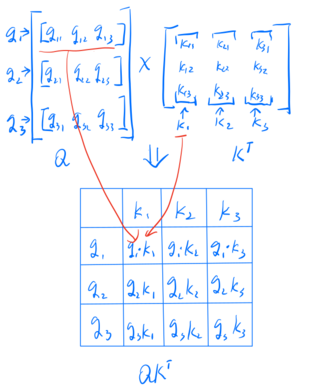
Using $QK^T$, we can get a table of how $Q$ attends to $K$. This is illustrated as:
Here is a simple self-attention implementation.
class SelfAttention(nn.Module):
    def __init__(self, d_in, d_out, qkv_bias=False) -> None:
        super().__init__()
        self.W_q = nn.Linear(d_in, d_out, bias=qkv_bias)
        self.W_k = nn.Linear(d_in, d_out, bias=qkv_bias)
        self.W_v = nn.Linear(d_in, d_out, bias=qkv_bias)

    def forward(self, x: Tensor):
        q = self.W_q(x)  # [N,d_out] , x @ W_q
        k = self.W_k(x)
        v = self.W_v(x)

        atten_scorce = (
            q @ k.T
        )  # [N,d_out] @ [d_out,N], meaning: [i][j] = ith token's attention to jth token
        atten = softmax(atten_scorce / k.shape[-1] ** 0.5, dim=-1)
        context_vec = atten @ v  # [N, d_out]
        return context_vec
Actually, attention from earlier tokens to later tokens makes no sense, so we need to mask it out.
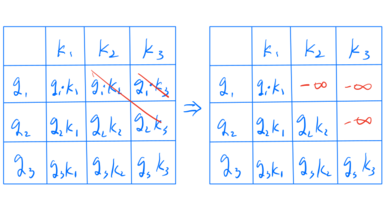
There is a math trick: instead of setting masked values to zero, we set them to negative infinity before applying softmax, thus, we can omit the re-normalization. This is a property of softmax:
\[\begin{align} \text{softmax}(x_1,\ldots,x_k,-\infty,\ldots)_i &= \frac{e^{x_i}} {\sum_{j \le k} e^{x_j} + \sum_{j>k} e^{-\infty}} \\ &= \frac{e^{x_i}} {\sum_{j \le k} e^{x_j}} \\ &= \text{softmax}(x_1,\ldots,x_k)_i \quad i \le k. \end{align}\]Here is a code implementation of this masking operation, and this attention is called Causal Attention:
class CausalAttention(nn.Module):
    mask: Tensor

    def __init__(
        self, d_in: int, d_out: int, context_len: int, dropout: float, qkv_bias=False
    ) -> None:
        super().__init__()
        self.d_out = d_out
        self.W_q = nn.Linear(d_in, d_out, bias=qkv_bias)
        self.W_k = nn.Linear(d_in, d_out, bias=qkv_bias)
        self.W_v = nn.Linear(d_in, d_out, bias=qkv_bias)
        self.dropout = nn.Dropout(dropout)
        triu = torch.triu(torch.ones(context_len, context_len), diagonal=1)
        self.register_buffer("mask", triu)

    def forward(self, x: Tensor):
        b, num_tokens, d_in = x.shape
        q: Tensor = self.W_q(x)
        k: Tensor = self.W_k(x)
        v: Tensor = self.W_v(x)

        atten_scorce = q @ k.transpose(1, 2)
        mask = self.mask.bool()[:num_tokens, :num_tokens]
        # upper triangular masking
        atten_scorce.masked_fill_(mask, -torch.inf)

        # if masking is set to zero, re-norm will be required, but use -inf, no need to re-norm
        atten = softmax(atten_scorce / k.shape[-1] ** 0.5, dim=-1)
        atten = self.dropout(atten)

        context_vec = atten @ v
        return context_vec
Multi-Head Attention
Instead of calculating attention blocks one-by-one, Multi-head attention integrates multiple Causal Attention heads and calculates them simultaneously.
The implementation is full of engineering details and the principle is the same, so I will not explain Multi-head Attention in detail here.
If you are interested, please refer to: Multi-Head Attention
Training
To be continued …